Wednesday, 27 February 2013

There are two Gladstones?

Leaving Carnarvon in our wake (some would say that this is the best thing that you can do to Carnarvon) we set a steady pace of 86KPH. The car's cruise control only works in 2 KPH increments, so 85 KPH wasn't an option. We had a pretty ferocious headwind and going any faster would a pure waste of fuel. Gladstone (Western Australia) was just three hours to the south of us and we had plenty of time to get there.

The North West Coastal Highway leading south is a fine piece of road, although just a bit boring. It is another of those trips where, for many kilometres, most of Australia looks like the rest of Australia. Worse still, we had covered this particular piece of road countless times as a couple and even more times by me as a solo traveller back in the days when I worked up and down the Dampier to Bunbury Natural Gas Pipeline. There would be no surprises on this leg of the journey.

Oddly, although I had travelled this stretch of highway so many times, I had never taken the time or trouble to drive the six kilometres into Gladstone, even though the turnoff is well signposted. Six kilometres is all that it may be, but when we turned off the nice, smooth, bitumen road onto the rusty, red, gravel road it was clear that it was going to take a while to do the distance - the road was extremely corrugated!

This was one of those times where I had to weigh up the benefit of letting the tyres down against the fact that we didn't have far to go and that it would take about an hour to re- inflate the tyres again when we came back out. Even more frustrating was that we only intended staying the one night and letting the tyres down for such a short run into a place for such a short stay didn't seem worthwhile. We didn't.....we should have.....

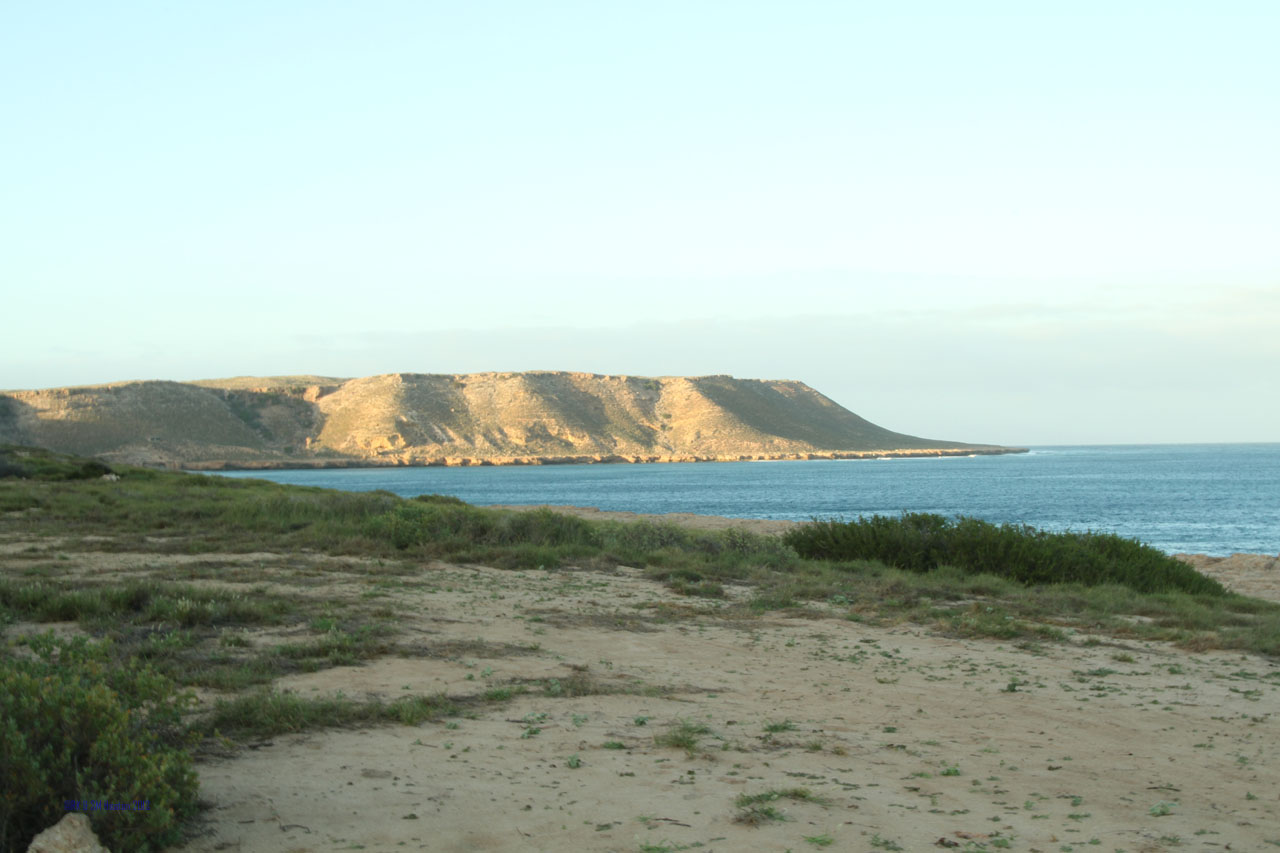
This is perhaps the only road/track I have ever been on where there was no respite from the corrugations anywhere. Every millimetre of the six kilometres was corrugated, badly. We took well over half an hour to get to Gladstone from the highway. On arrival,, the first thing that you notice is how flat the area is. The campsites are distributed along a stretch of shore front tracks, some with views of Shark Bay, others have their view obscured by saltbush, and all not more than 500mm above the high water mark.

There is a single toilet block comprising of two flushing toilets (that were solar powered and stopped flushing after dark - if they were battery powered, then the battery was clearly knackered.) Next to the toilet block is a dump point for those, like us, whom are self-contained that way.

On the other side of the main entry track from where the toilets are located is the caravan belonging to the "caretaker", a rotunda and the remains of the old Gladstone Jetty (which was used to send out the wool clip from nearby sheep Stations.) There is a rock groin that goes out to the start of the jetty but the wooden jetty itself is in a state of complete disrepair and has been secured to prevent access.

Gladstone: The Rotunda, the beach, the rock groin and what's left of the jetty
While we were travelling to Gladstone the screaming breeze had ebbed away to almost nothing and the sheltered waters of the eastern side of Shark Bay had barely a ripple on them. It was easy to tell from the slope of the sandy/muddy beaches that the water was very shallow and that one would have to go out a long way to get into any reasonable depth. The water was not clear, but not too silted either, considering the make-up of the beaches.

The tide is about halfway in. That is the Caretaker's dinghy. He leaves it there with all of his fishing gear in it.
We wandered over to the rotunda and were immediately beset upon by the "caretaker". This guy was a picture! He was rakish in build, save for the beer-gut from Hell, about 5' 6'' tall, clearly hadn't seen a razor in a very long while, had the hugest "grog nose" that I had ever seen, was as brown as a berry from prolonged exposure to the elements, had a can of grog in one hand and smelled as though he'd been on the grog for several days.

He pointed over to his caravan, which was an old Windsor or similar, about 22' in length and sagging down at both ends, was surrounded by all manner of junk and rubbish, had a little generator screaming its lungs out and had no shelter such as an awning or annex. "I'm the Caretaker" he pronounced, before adding "but not at the moment. I only work during the tourist season. The rest of the time I just live here." He then proceeded to give us the full "caretaker spiel" as though he was, in fact, on duty.

By the time our new friend had finished talking we knew everything we needed to know about the place (except that the dunnies would stop working after dark), including where the only place was that I would be likely to catch fish. He later went out to that spot in his dinghy, bobbed around for a couple of hours and then came back empty handed, so I'm glad I didn't go to the trouble of taking the kayak off the roof and going fishing.

We walked back to the vehicle and van and parked at the original site that we had thought might be OK. It wasn't long before the awning was rolled out and the bar was open. We had a lovely, peaceful, evening watching the Sun set as the tide marched in and a thunderstorm rolled overhead, dropping a few minutes of welcome rain on us. I was almost tempted to stay another day but Sue wasn't keen and we resolved to move on the next morning.

The thunderstorm was brewing, making for an excellent sunset to view while enjoying a couple of bevvies

As a short-stay or overnighter, Gladstone is worth considering. It is fairly basic, but it is cheap at $6.00 per head per night. I wouldn't recommend swimming there, unless at high tide, when the water does come up over the sandier part of the beach. We watched people launch boats there (in fact we witnessed something that neither of us had ever seen before - a car jump-starting a boat) and netting is allowed at one section of the beach. The road in and out is definitely an issue and, once again, is in the Shire of Carnarvon, so it probably only gets a cursory scrape over with a grader once in a blue moon, just like the road from the Blowholes to Gnaraloo.

You don't see this every day. A boat being jump-started by a car!
The rain that we got had completely dried by the morning, which is just as well because signs in the area clearly indicate that if the road is wet it's closed, and, if it's closed it is an offence to drive on it. The penalties are $400.00 per wheel of your car or rig that is on the road. (That would be $3200.00 if we were to drive over a closed road with the van hooked up!) Never ignore road closed signs in WA.

We set off early, knowing that we had a slow haul ahead of us, getting over the same corrugations that thumped the bejesus out of us the previous day. Never before did the North West Coastal Highway look so good. We turned south, our destination being Geraldton, where we would stay at our Son's place for a while and do some work on the van. We had discussed the interior windows in the van which, quite frankly, had pee'd us off from the day that we took delivery of her, and had decided that they had to go. this would be one of the projects to get done during our stay, but we'll leave that for the next issue.....

Tuesday, 26 February 2013

Loo with a View

The journey to Carnarvon took three and bit hours, not including our breakfast stop. We tossed a coin and decided to stay at the Top Tourist Park, called the Wintersun. The park was almost empty, save a few backpackers and permanents and although we had been allocated a site, we ended up setting up on the site next door (easier access and a better concrete pad.)

I got straight into the "boy stuff" like getting the filtered water going into our tanks, setting up the awning and so on, while Sue busied herself with the washing. A quick trip into town for some fresh produce, replacement lures and fuel ensued, and then it was back to the caravan park for lunch. Fresh bread, for the first time since we left Cossack,was a treat to be savoured. Sue has cooked bread in the past, but for this trip we were making do with cracker biscuits, rye crispbreads and similar.

The afternoon was filled in by doing some small jobs that crop up while travelling and before I knew it, it was time to start preparing dinner. With all of the fresh produce that I had just purchased, what else could we have but a fresh Laksa? On  this occasion I used chicken as the base for the Laksa, but we often have a mix of prawns, fish and squid. Aromas from the freshly crushed garlic, ginger, lemongrass, basil, chili and onions wafted on the breezed, inviting more than one comment from passers-by.

As always, the laksa was excellent and was washed down with a couple of quiet bevvies. Over dinner we had decided to head north the following morning. Initially we were going to make for Gnaraloo Station, but while talking with two separate groups of people at the caravan park in Cararvon, we were put off the idea. It seems that the entry fee is $20.00 per person and for that you get a site that is some distance from the beach, some salt-water showers and long-drop dunnies.

Plan B was to go up the same road, but only as far as Red Bluff and this is where we headed after a good night's sleep and a cup of freshly brewed coffee the next morning. To get to Red Bluff, you must travel north on the North West Coastal Highway until you reach the turn-off to the "Blowholes". For us, this meant back-tracking a bit, heading back toward Warra,  but we didn't mind - this was all new territory for us.

A well made bitumen road slides under your wheels all the way to the Blowholes and we made good time getting there. You know you are getting close when you see the lighthouse on the hill. We parked in the spacious parking area, giving ourselves enough room to drive in and out again, without having to do any reversing manoeuvres. We each served ourselves a bowl of cereal and walked the short distance to where the blowhole was pumping its powerful surges of foam, spray and scree into the air.

The wind was strong and the sea was angry, making conditions for spectacular eruptions just perfect. Sue backed away fairly soon (she was feeling cold), leaving me to wander as close as I dared to the source of the noisy explosions of water. There are signs everywhere about King Waves and how many people have died either fishing from, or viewing, the blowholes and I wasn't about to become a statistic. I watched the blowhole and I watched the approaching waves. On one occasion I literally ran away from the edge as a very large set of waves approached the craggy shoreline and crashed onto the rocks.

I decided to get one of the cameras (the least expensive one on this occasion as I didn't want to get the SLR camera covered in salty spray) and walked back as close as I dared. Unfortunately, the very large waves that I saw earlier had put the wind up me and I had to stand well back and use the zoom function to take my snaps. As a result, I didn't get the spectacular shots that I was hoping for, but even at that distance I was forced to make a couple of dashes further from the edge, in order to prevent myself from being soaked to the skin by the enormous waves that battered the coast.

This explosion of water was almost 10 metres high
Mission accomplished, we piled into the vehicle and took a drive around the camping area at the Blowholes. The official camp area is a few kilometres south of the Blowholes themselves. It consists of a series of tracks that meander along the coast, just back from the fringing rocks and dunes. Interspersed along these tracks are shacks that have "evolved" over the years as locals from Carnarvon have cobbled together makeshift rooms with whatever building materials were at hand.

This higgledy piggledy array of dishevelled buildings we almost all occupied at the time that we visited - it was school holidays after all. Most of the occupants were keeping sheltered from the incessant winds that had announced their presence at Warra the previous day. Who could blame them? We had seen enough and decided that we didn't rate this site as worthwhile for spending time there on this occasion, so we turned north and followed the corrugated road north in the direction of Quobba Station.

Now, I don't want to put people off, but this road clearly only gets a licking with a grader about once per year. It was in very poor nick and progress was very slow. We were relieved every time the coast appeared on our left and was picturesque enough to warrant a photograph or two. Stopping brought a sense of sheer relief to our pummelled backsides.

Scenery like this gave us an opportunity to rest our bums after the pounding we were getting on the road up to Red Bluff.
We also took a detour to have a look at the wreck of the Korean Star, a ship that ran aground at Cape Cuvier many years ago. Unfortunately, we were unable to see any signs of the ship's carcass due, I guess, to the constant pounding of the huge seas. What we did see, however, was quite remarkable. As we stood high on the cliffs that overlook the salt loading facility for Rio Tinto's salt mine at Lake McLeod, we saw the tiny shapes of two intrepid fishermen below us. (Yes, I used the gender specific term "fishermen" because they were, in fact, men - so please don't call the PC Police onto me.) What was so remarkable about that, I hear you ask? Well, one of the fellows was leaning back real hard, obviously hooked up to an enormous fish. The rod was bent severely and he was clearly not using light fishing tackle.

Click on this image to enlarge it. Take note about a third of the way in from the left and a third down from the top. That's what he was hooked into!
Another Couple, whom had been watching the fishermen for about half an hour before we got there, pointed out a short distance from the shore and there it was....a whacking great Tiger Shark, obviously hooked and struggling to make good its escape. Nearby were a further three Tiger Sharks of similar proportions (at least 3 metres in length) and these sharks were shadowing the hooked shark. Apparently the battle between shark and man had gone on for at least the half hour that the other Couple were watching and continued for another 15 minutes as we watched. The shark was showing signs of tiring, but not enough that the two guys could demonstrate clear superiority while they were taking it in turns to break their backs as they tried to subdue this monster of a fish.

We gave up watching before the battle was over,but one could assume that at some point the fishermen would have cut the line and let the fish go, because there was absolutely no way that they would have been able to haul it up the rocks (and why would they want to?)

I might add that this entertaining display was probably all that made the diversion into Cape Cuvier worth the trouble. While it is certainly scenic and, in some respects interesting to see the salt wharf, the track itself was abysmal and I certainly wouldn't drag the caravan over it again. You have been warned!

Back onto the main road ( if one can call it that), we bumped and bashed ourselves along until finally reaching the welcome turn-off into Red Bluff. Just two minutes into the trip off the main road and we found ourselves trying to invent a ratings system for roads that basically worked on a scale of  "Pretty Bad" down to "You're Kidding, Right?" The track into Red Bluff was closer to the "You're Kidding, Right?" end of the scale - actually, it would probably be the benchmark for setting the "You're Kidding, Right" value to all future roads (tracks?) that we traverse.

Many of you will know that feeling you get when you just want to turn around and drive back out before you get to a place, just because the road is so bad. Well, I had that feeling, but it is always accompanied by the thought "If we turn around now, we have endured this God-forsaken nightmare for nothing." And so we soldiered on. Finally, we saw the Bluff in the distance. We had driven many kilometres north on the main road, only to find ourselves back-tracking to the south along the crappy Station track that would take us to the campground. The Bluff was still many kilometres further south of us and took a considerable amount of extra time to reach.

You know you are getting close to the campground when you start to see small clearings beside the track, each accompanied by a strange looking shelter made from Palm fronds. We had no idea what these structures were, but were soon to find out. The twisting, turning, corrugated, track continued until we found ourselves outside the "Homestead", which I believe is actually an outstation of Quobba Station itself.

Sue went in and paid for two night's accommodation (at $11.00 per person per night), while I tried to figure out where to turn around. I asked the lady whom served us whether there was a place further ahead where we could just simply drive around a "loop" and head back to a campsite that had appealed to us. Apparently there wasn't. "We don't get many caravans in here." was the reply. I'm not surprised, after experiencing the road we just came in on. Tricky reversing and multi-point turning followed, before we successfully found ourselves facing the other direction, without having hit anything in the process.

Did I mention that the West Coast sea breeze was blowing? Well, I should say that it was howling and it forced our hand when it came time to select a camp site. We had little choice but to camp in the lee of a small, low stand of Tamarisk trees. They offered the only protection around, while still giving us the opportunity to view the ocean and the Bluff.

The Tamarisk trees may have been small, but they were the only available shelter from the wind.

While I set about getting the awning rolled out and the all-important corner legs wound down, Sue went exploring. She came back to report that the little shelter made of Palm frond, situated some 20 metres away, was in fact a dunny. Within the flimsy confines of the wire and frond walls was a long-drop dunny - not just your ordinary, everyday long-dropper either - this one was partially filled with sawdust. Next to it was a 20 litre pale of fresh sawdust and a scoop to use to cover your "doings" with a new layer.

The loo with the view.
This marvellous piece of engineering had none of the pongs usually associated with long-droppers, and even had a slight flowery fragrance, obviously the result of something that our hosts tip into the bowels of the thing to abate any evil odours. Poo tickets were provided and they even had hand sanitiser to finish up with. The pièce de résistance of this dunny was the door.....or should I say, the lack of one. While sitting on this loo, going about your business, you are treated to wonderful views of the coastline as it stretches north of our campsite. Could one possibly ask for more, while spending a penny in our rugged north?

The view from the Loo with a view

After setting the van up we set off to explore the area. The Lady was right about there being nowhere to turn the van around. Camper Trailers? Possibly, but not without some manoeuvring. There was no shortage of campsites, just a shortage of "I've changed my mind and want to turn around" spots. Many of the camp areas had a small clump of Tamarisk trees and almost all had the obligatory Red Bluff Long-drop Special. There were three separate "shops" with advertising hoardings promoting all manner of goodies - ice creams, fizzy drinks, pies, pasties, sausage rolls and even fancy coffees - but only one of these places was open, the place where we paid for our stay.

The only beach was almost at the base where the Bluff juts out from the coast and, at best, could be described as risky to swim at. At a certain point  during the tide cycle, a small, natural, rock pool forms on the shoreline which would be the only place that I would let a child swim. Still, people don't generally come to Red Bluff for the swimming - it's the surfing  and fishing that attract the lion's share of the visitors. I was hoping to do a bit of the latter the next morning.

The rest of the afternoon was spent huddled under the awning of the van, trying to get some respite from the howling wind. The only saving grace was that the wind was keeping the temperature down to a respectable range in the mid to high twenties. We had no trouble sleeping that night and Sue even pulled a blanket up to keep warm.

Red Bluff (doesn't look all that red, does it?) in the morning.

Wind? What wind? What I thought was a strong breeze the first day that we were at Red Bluff, must have been nothing more than a mere puff. This is because when we awoke on the second day, the caravan was rocking and rolling as the sheer force of the gale buffeted the body of our home and we even had the corner legs wound down! No, we weren't going through a storm, this was just  the sea breeze blowing with a vengeance. Still, nothing was going to put me off fishing, so I gathered up my gear and made my way to the Bluff.

I walked out to a where the water seemed deep enough and had a promising mix of reef, weed and sand. I rigged with one of the trusty, white, soft plastic lures that had been so effective at Warra and cast it to where I thought it would work its magic. Ha! What a joke! All that happened was that the wind (which was side on to me) caught hold of my very fine, thin, 4 lb  braid line and dragged it at a million miles per hour, causing the soft plastic to skip along the surface rather than sink to where the fish may be.

Several casts later I realised the futility of what I was doing and added a sinker to the nose of the lure. This was still no good. I just couldn't get the lure to sink to where it was needed. OK, off came the lure and on went a hook, a very heavy sinker and some squid for bait. I chucked it in to where I thought would be a likely place for fish to hang out and waited. And waited. And waited......

Not only did I not get a single bite, but the only fish I did see were small and were weed-eaters. I am a patient person when fishing, but after two hours of this I gave the game away and went back to camp. Sue was in the van when I arrived, trying to seek shelter from the wind. We both spent the rest of the day reading, apart from when I ventured back to the Bluff to watch the surfers take on the swells generated by the strong wind. Alas, the surfers had even given in to the wind and none were out plying their trade.

Many of you know that we don't like to cook in our van, especially very fragrant dishes. So, that evening we had to go to elaborate lengths to construct a wind-break around our camp stove so that we could cook dinner. We got it done, but I'm sure that we used twice as much gas as we normally would.

Even though we didn't relish the thought of traversing the crappy track into the Bluff again, it was a better option than hanging around for another day, getting blown off the face of the earth and so it was that we decided to leave as scheduled the next morning, rather than extend our stay. It proved to be a good decision as the winds had not abated overnight.

We bumped and ground our way over the lumps and corrugations, taking over three hours to return to the bitumen at the blowholes, where we stopped and re-inflated our tyres. From there we made our way to Carnarvon, filled with fuel and parked close to the Woollies store to get provisions for the next leg of our journey - Geraldton, via Gladstone (Shark Bay).

While we were at the parking place by Woollies, another vehicle parked close to us and out jumped two people, two dogs and three feather-foot chooks. That's right, they had brought their chooks along for the ride. As it turned out, these folk were camped at Bush Bay, south of Carnarvon and when they come into town for their stores, the entire "family" comes along for the ride. We had been told that Bush Bay was populated by itinerants, and these people confirmed it.

Provisions purchased and stowed, we made our way out of Carnarvon, a place that to me at least, always looks good in the rear-vision mirror of the car. Next stop: Gladstone.....


Tuesday, 5 February 2013

Interlude: The Demise of the GoPro Camera

I forgot to mention the demise of the GoPro camera in the Warroora post. Many of you will have seen or heard of GoPro cameras. They are a very small camera, cable of shooting still photographs, movies and so on. They come with various housings and mounts for various uses of the camera. This is where I came unstuck.

I had gotten into the habit of taking my GoPro camera on fishing trips, to record unusual or very large fish captures. I have been doing this for several months, storing the camera in my fishing bag or bucket, inside an old sock to prevent the lens from getting soiled and scratched. I had purchased an attachable back for the camera, which enabled me to view the subject matter before and during shooting. This video backpack came with its own selection of cases to protect the camera.

Most of the cases are degrees of being absolutely waterproof to 60 Metres deep, to having and opening in them to let the sound get to the microphone easier. When I installed my video backpack I thought that I had installed the waterproof back......

As described in the post about Warra, we got a lot of rain. The GoPro was in the fishing bucket and the fishing bucket was out in the rain. Let's face it, there was nothing in the bucket that water was going to bother, right? Wrong! Even with my glasses on, I had failed to notice that I had installed one of the cases with some small holes in it (to let more sound in.) Even though I had taken the camera out of that case many times, to either recharge the battery or download the shots from the memory card, I had failed to see the holes in that cover.

Next day, the camera was swimming around in the bucket and I took it out of the old sock to dry it and use it. Can you imagine how I felt when I saw water dripping out of the "waterproof" case, not to mention being able to see water inside the case sloshing around? I was devastated. I was a career electronics person and I knew, without so much as testing the camera, that it would be stuffed. Sure enough, closer examination revealed green stuff growing where green stuff didn't oughta be.

Surprisingly, the memory card survived and I was able to download the two clips that were on it. That was the only good news though. Naturally, I have replaced the camera and, naturally, a great many of extras and accessories from the old camera are not compatible with the new one. Even the memory cards are different. I will be using a microscope when I fit covers to the new camera.

Warroora and the Missing Sea Breeze

We had enjoyed our stay at Ned's Camp immensely and it was time to move on to Warroora. Although a tad warm at times, due to the complete lack of a sea breeze during our stay, the calm sea conditions and lack of wind-blown dust had more than compensated. Our batteries held up despite the cloudy conditions reducing the amount of solar charging that we were able to achieve, but I decided that on the way to Warroora I would connect the car and caravan together for a short while, just to give our power source a bit of a top-up.

Most of the packing had been done the evening prior, so all that remained was to have a cup of coffee, wind up the legs of the van and hook the car up. We were on our way by 7:30 AM (no point in leaving too soon as we wanted to pick up a few things from the shops at Exmouth.) and the drive up the west side of the Cape, around the tip and back down to Exmouth was completed in what seemed like a blink of the eye. It was a nice change to have a temperature in the twenties showing on the car's thermometer!

For those whom have not been to Exmouth, there are two supermarkets in the main shopping precinct, both within sight of each other, both members of the IGA chain and both with comparable prices, so it matters not where you choose to shop. We purchased a small gas stove, the type that uses those disposable canisters of gas, having found out that the one that we had brought with us was in no mood to comply with our wishes to cook food. (Cooking a Laksa inside the van was not ideal as the smell can be very hard to get rid of.)

Stores purchased and stowed, we stood under the shade of some trees near where we parked the rig and had our breakfast, before heading south to the turn-off to Warra. The road south from Exmouth, though bitumised, has its moments. It is quite narrow and bumpy in places and when towing a van I didn't relish the sight of oncoming trucks or other caravan rigs coming toward us. In one place we did have a minor slip off the road with the left-hand caravan wheels, but the rig maintained its line and pulled back onto the bitumen without too much of a fuss.

There are two turn-offs into Warra. We would be taking the north-most turn-off, but for those coming from the south, I would recommend that you take the north-most turn-off anyway. From the north you need only to traverse 12 Km of crappy, corrugated, gravel surface. If choosing the southern approach, you have 38 Km of crappy, gravel surface. So, even though coming from the south is shorter if you take that route, it is worth staying on the bitumen and going in from the north - you will save time and endure less discomfort, not to mention reducing the wear and tear on your transport.

When I say that the road is crappy, the first six Km was really quite bad, taking nearly 30 minutes to cover. The remaining six Km was better, but still corrugated and required us to drive on the wrong side of the track in places, just to avoid the shaking that comes with corrugated roads. Seeing the ocean again was a welcome sight, even if the low-light of seeing the Warra rubbish tip had to also be endured before reaching our destination. There are no rubbish bins at Warra, but there is the communal tip (which also has a dump point.) Speaking of dump-points, you cannot stay at Warra unless you have a chemical toilet.

When you arrive at Warra, the reddish gravel track gives way to stark, white sand right at the Caretaker's residence. Don't be alarmed, the beach sand is firm enough to drive vehicle and van on without trouble.

Taken at dawn, this shot shows how firm the sand tracks are at Warra.
We came to a halt beside the Caretaker's camp and were greeted by Ross, a very jovial, very large man. Ross welcomed us, pointed out the different places where we could choose to camp, gave us a spiel about the local fishing rules, took our money and stated that we could expect at least three more days of good weather without strong winds.

We took a walk to the south, where the camps were a little less exposed to the elements and chose a site that was large enough for our rig and reasonably level. Reversing the rig was a cinch, given that we had the entire beach in front of us on which to manoeuvre the vehicle, and soon enough we were set up. Our site was nestled in a scalloped out area between some small sand dunes which had a sparse, but effective wind-break of coastal salt bush. The view from under our awning was unimpeded by anything, giving us about a 160 degree sweep of the seashore, out to the breaking waves of the Ningaloo Reef.

The sites are very "natural", being little more than indents in the dunes. Notice how I was forced to use the "banjo" to dig a hole for the right-hand side wheels to sit in, in order to level the caravan. The back of the van is also sitting on the dirt.

It was after setting up the camp that I realised that I had forgotten to disconnect the caravan and vehicle power connection on the way down from Exmouth (as I had intended to do.) In a state of panic, I opened the boot and quickly cycled through the solar charger settings to see what the maximum voltage had got to. While being a great source of power, Lithium batteries are very intolerant of voltages outside their operating range. To my relief, the voltage had gone no higher than 13.9 Volts, still 0.2 Volts under the maximum that I have set the Solar Charger for. No harm done!

We had some lunch and I went for a wander along the beach, chatting to other campers and asking questions about the fishing in the area. (Sue calls me the "Caravan Park Pest".) Many of the folks at Warra had been there for some time. They were enjoying the unusually wind-free conditions and had taken advantage of this to do plenty of fishing. Catches were mixed and, from what I could gather, related mainly to the experience of the fisher, rather than to what was actually available.

I also spent some time talking to Ross and was surprised to learn that a former work colleague (who shall be known simply as "Stewie") was the caretaker at the next campsite to the south, a place called Sandy Bay. From Ross' camp I took a wander up to the camps to the north. ("Dalkeith" as Ross called it, named after an exclusive Perth suburb.) These folks set themselves up for the long-haul, having a plethora of tents, shades, shade cloth fences to stop the windswept sand, solar panels, generators, fridges and freezers and an array of boats and kayaks. They were also a lot less inclined to have a chat than were the "southerners".

We spent the first afternoon relaxing, reading and, in my case, setting up my fishing gear and the kayak in preparation for the next day. We contemplated a swim, but the water was very clouded with a whitish suspension of fine sand particles, making visibility difficult. With the knowledge that a woman was bitten by a shark at Warra a couple of years earlier, we decided to hold off having a swim until the water cleared.

We enjoyed a BBQ'd steak and salad for dinner and watched the Sun set over the reef before getting an early night. The thing I noticed most about the following dawn was the absence of bird calls. We had seen some honeyeaters the previous day, but clearly they were elsewhere in the morning. I fluffed around a bit too long making final preparations to go fishing in the kayak, something that would have consequences later. I hit the water about 8:00 o'clock and paddled toward the reef, looking for patches of ground that were similar to where I had learnt my new fishing technique at Ned's Camp.

Unfortunately, the signs I were looking for were not not there and the Spangled Emperor I did catch were small and were returned to the sea. Eventually I decided to paddle to the Ningaloo Reef itself, but I had left my run too late and the incoming tide was so strong that I could not make any headway, so I paddled over to some weed patches and was able to catch a few small squid. The squid were a perfect size for bait and I stowed them away for the next day. I had learnt a couple of lessons about conditions at Warra and resolved to get on the water a lot earlier the next day.

I made my way back to shore and stowed the kayak and fishing gear before wandering back to the van and enjoying breakfast. Sue had been for a long walk and was able to fill me in on the other camping grounds in the area. This place was set up for the winter throng of grey nomads and appeared to be cable of accommodating at least 100 rigs, albeit with only 30 or so on the waterfront. As the day progressed a smattering of clouds began to fill the sky, but without the benefit of a forecast we did not know what the future held. We were to find out soon enough, and it was a blessing. Meantime, one of the other "southerners", Duncan, had invited me to go fishing with him in his dinghy the following day.

The following morning dawned almost completely overcast. Conditions at sea were still completely calm, which was just as well because Duncan's dinghy was little more than a flat-bottomed punt with very short sides and bugger-all freeboard once loaded with us and our gear. We rolled the boat down the beach and into the water where, after more yanks on the starter cord than I would have preferred, the engine roared into life and we were on our way. We headed straight for the fringing reef, hoping to get amongst the Spangled Emperor that we knew would be hiding there, but in what was perhaps an omen, Duncan noticed that he had forgotten his tacklebox in his hurry to get going. I was starting to wonder about Duncan because he has also left Perth without his life-jackets and we were using those from my kayak!

I had enough tackle for us both and we kept going. Even though the fringing reef breaks up the waves and creates a calm surface inside the reef, the boiling surf and thunderous crashing of the waves, along with the current that the waves produced,  had me a little concerned. Before we even got within 100 metres of where we needed to be it was evident that the seas were too rough for the tiny boat we were in and we erred on the side of caution, turning back toward the shore. We made for a rocky outcrop and dropped anchor a couple of  hundred metres from the headland. The bottom consisted of patchy weed and intermittent rocks, not ideal for Emperor, but likely ground for squid.

I caught several small Cod, known colloquially as "Charlie Courts" (after the WA Premier from the '70s, who was regarded by all to have a "big mouth") before Duncan spotted a few squid near the rear of the boat. A quick change of rig brought instant results and before long the small vessel was being liberally coated with squid ink. Unfortunately, the other squid were very skittish and after seeing their mate get captured, they all disappeared into the shadows, never to reappear.

We fished for a while longer without luck and although the conditions were almost completely calm, Duncan announced that he was feeling a bit green around the gills and we made our way back to the beach - Tally: 1 squid (although it was a honker!) Perhaps things would pick up tomorrow?

Lunch was, naturally, freshly cooked squid rings - yumm! The afternoon was spent lolling around reading and preparing tackle for the next day. Sue went for a long walk and came back to report that she was completely snubbed at "Dalkeith". The weather was very overcast and we were at about 73% of our battery capacity by dusk. We slept soundly that night, with the only sounds to be heard being the crickets chirruping and my legendary snoring.

Duncan and I had learnt a lesson about the sea conditions the previous day and so it was that we were on the water bright and early. We made straight for the outer reef and, although a little choppier than we expected, we were able to wet a line. Duncan chose to use bait and I used soft plastic lures, which turned out to be a good choice with the first Spangly coming over the side within minutes. There was no need to break out the measure because this fish was obviously well above the legal minimum for the species. In quick succession two legal sized Red Throat Emperor were caught, then several small Cod which were returned to the water and finally another Red Throat came over the side before we decided to call it a day.

Duncan was not a confident skipper and the fact that we realised (once we were out there) that we hadn't put the kayak life jackets in the boat, meant that we had to be happy with what we had caught and return to shore. Poor old Dunc hadn't caught a keeper, but I gave him a couple of the Red Throats and kept the Spangly and a Red Throat for myself.

All this time we had still not been exposed to the famous west coast sea breeze and were grateful for it, but the downside was the heavy cloud cover. The batteries were down to 56% of capacity by the time that we got back from fishing - not enough to start rationing power, but getting a bit worrying. Duncan has a small generator and offered us the use of it while he and his Wife went to Coral Bay for some stores. Even though we were going to move on the next day and would be able to use the car to charge the batteries, I accepted his offer and three hours later the batteries were full to the brim.

About mid afternoon we started getting some sporadic rain showers. The rain wasn't heavy but it was starting to wash the dust from the van and car. By about 5:00 PM the showers had merged together to become constant rain. I let about half an hour of rain pour off of the awning, before commencing to capture the water in whatever we had at hand. After filling up a 30 litre esky, two 20 litre buckets and a five litre water bottle, I decided to pump the captured water into our under-van tanks. I filled the general purpose tanks first, then the drinking water tank (ensuring that the water was the cleanest of all because all of the dirt and dust had well and truly washed off the awning by then.)

By the time the rain had eased we had full tanks all-round and about 60 litres in various containers. We no longer had to leave Warra due to water storage, nor because of power, thanks to Duncan's generator. It took no discussion to decide to stay on and the next morning I wandered over to Ross' camp to pay for three more days. 

Later that day I had to do the most feared job of all when caravaning - empty the toilet cassette. As much as I try, I have never been able to convince Sue that this is also a pink job and is not strictly a blue job as she seemed to think - to no avail because she has never volunteered for the task. I drove to the tip/dump point and did the dastardly deed and was on my return journey when I noticed a vehicle in the rear-view mirror. It took a little while but I eventually recognised Stewie at the wheel. I stopped my car and got out, only to see Stewie veer around me and drive on. His window was down, so I yelled his name as loudly as I could. The brake lights came on, followed by reversing lights and Stewie was soon beside me.

Stewie got out of his vehicle clutching a UDL can of some sort of alcoholic bevvy and stared at me for a while. I took my sunglasses off and the expression on Stewie's face changed from one of puzzlement to one of happiness as recognition finally dawned on him. We shook hands and had a good old chin wag for quite some time. Since I had last seen Stewie he had become a member of the Royal Flying Doctor customer lounge (he was using the service so often.)

He had: Dropped the "A" frame of his off-road caravan onto his foot and crushed his big toe so badly that it required amputation; Got bitten by a Western Brown snake as he tried to shoo it away from his pet goat; Oiled himself up with coconut oil (instead of using sunscreen) and got first degree burns all over his upper torso, the front side of his arms and legs and his feet! He has got new skin there now, but he can't expose it to the Sun at all, so he wears some long trousers cut-off well below the knee and long-sleeve shirts. His hat is one of those sombreros about a metre in diameter.

To say that Stewie is eccentric would be an understatement. He lives alone (aside from the goat and a pet sheep for company) at the Sandy Bay camp on Warra, having only the occasional visit from friends and the company of tourists to keep him abreast of what's happening in the World. He visits Ross at the 14 Mile Camp (where we stayed) and Ross has taken to calling Stewie "Captain One-Way" because Stewie sails his kayak up to visit Ross but then is either too drunk to sail it back or too tired or the wind is against him. Ross is left to take Stewie home again after the social visit. Stewie and I parted but he promised to catch up with us the next day at our camp.

Sue and I rounded out the day with a feed of fresh fish and the last of our salads. We had been eating our fresh produce on the premise that we would be in Carnarvon the next day, and certainly hadn't banked on getting the rainwater for our tanks. We retired early and this time we didn't even have crickets to serenade us - the rain must have washed them away.

Next morning I got up early and took off in the kayak, heading straight for the outer reef before the tide and currents made it too difficult to be safe. Half an hour later I dropped the anchor at what seemed a likely spot and cast a soft-plastic lure next to a rocky formation (bommie). Within minutes I had hauled in several small Cod, releasing them all, but it wasn't before having a bit of a scare. With the anchor out and what little breeze there was, I found myself side-on to the current. The kayak bucked underneath me, quite violently a couple of times, and I was forced to pull up the anchor and drift-fish.

The problem with drifting is that I was only able to get one cast in before being swept a long distance by the current. This necessitated a fairly strenuous paddle back to the "likely spot" before I was able to cast again and start the entire process over again. I got monstered on one occasion, losing my rig to the sharp coral as the fish sought protection. It must have been a big fish as I was unable to slow its progress at all.

I was starting to tire, literally and mentally, of this constant paddling and was delighted when, after losing several rigs and catching only small Cod, I hooked and landed a very respectable Red Throat Emperor. Having tasted success, I was only too happy to return to shore and was quite grateful for the following tide and breeze that made the paddle back an easy task.

I cleaned the fish before cleaning the kayak and fishing gear, satisfied with my efforts and not really requiring any more fish for the remainder of our stay. Sue and I try our hardest not to freeze fish, preferring it fresh, and had enough vacuum-sealed portions of fish in the 'fridge to last us for a while. After that I had a very late breakfast, just managing to finish it before Stewie rocked up, bottle of Gin under his arm, a schooner glass and a bottle of soda water in his hands. The tide on the Gin bottle was about halfway out and the soda water looked pretty warm....

Stewie gave Sue a hug and I watched as she squirmed. He was lathered in sweat and still had the same clothes on that I had seen him in the day before! Pleasantries dispensed with, we all sat down and spent many hours whiling away the time with conversations about times gone by - former lifetimes, if you like. Stewie knocked off the rest of the Gin and from his snippets of conversation, it was clear that he spent the lion's share of his time in a state of inebriation, although he was as sharp as a tack when it came to remembering details.

It must have been at least three hours before Stewie bade us farewell and drove the 60 or so metres to Ross' camp. We didn't see him again that day but were to catch up with him the next day (New Year's day.)

We spent New Year's Eve having a couple of quiet drinks, enjoying the sunset that was made all the more spectacular by the cloud cover that still persisted, and captured a bit more rainwater from the very few showers that continued into the evening. Although there is not an abundance of wildlife at Warra, we were able to observe some 'roos, a variety of sea birds, some small hawks (I think they may have been Gosshawks, but it was difficult to tell, they didn't approach too closely) and we had a lot of fun watching the little Tata Lizards.

Tata Lizards are named (colloquially) because of their habit of coming to an abrupt halt, then lifting one or the other of their fore-legs and waving it in the air - as though waving you goodbye.) They are around in large numbers at Warra and it would seem that their diet is made up almost completely of bush flies. They are very athletic and I witnessed one jumping vertically, the full length of its body, and snap a passing fly out of mid-air. Ross told me that after the lizards got used to him being around, they would climb up his legs and catch any flies that landed on him!

We had one of our usual New Year celebrations - in bed and out to the World by 9:00 PM! The crew at Ross' camp, numbers swollen by the arrival of his Son and his family, may have partied on but we never heard a thing.

New Year's Day started in bright sunshine, a pleasant change from the previous days, but also heralded the start of the dreaded sea breeze. It was little more than a puff at dawn but had become quite strong by midday. Most of the campers at Warra took advantage of the warm, sunny, morning and were dotted up and down the shoreline, swimming in groups, but by lunch time the beach was deserted as everyone sought refuge from the wind. We spent some time having a quiet drink with Ross' mob and Stewie, before heading for shelter late in the afternoon.

I packed away as much stuff as I could that evening, ready for our departure for Carnarvon the next morning. We had a BBQ in the wind later that evening and then sought the shelter of our van for the night. During the first few days of our stay we had Internet access via the mobile phone tower at Coral Bay, but it seemed that the ferocious sea breeze was actually able to blow the signals back up the beach, because we weren't able to get through that night. Never mind. We had just had the longest stretch of sea breeze-less days that I can ever remember - 10 days.

Next morning we did our usual trick of quietly packing away the last few items, downing a freshly brewed coffee and heading off to our next destination, Carnarvon. I took a couple of quick photos, something that I had completely forgotten to do in the previous six days, and we were on our way by 6:30 AM. Not surprisingly, Big Ross was awake and he gave us a wave as we turned off the white sand of the beach, onto the rusty, red, soil that marked the start of the twelve kilometres of corrugated crap road.

Next issue....."The Loo with a View"


Friday, 25 January 2013

Christmas Day at Ned's Camp

Previously I made mention of the German tourists whom decided that a cigarette paper thickness was all the room required between adjacent campsites, and how I had warned them of my loud snoring. - well, the first thing that I noticed upon the rising of the Sun on Christmas Day, was that they had moved during the night. Neither Sue nor I heard the vehicle start, so we can only assume that they pushed the car out and across the car park to the far side - very considerate of them. So began Christmas on the beach at Ned's Camp.

Pancakes with strawberries and cream, freshly brewed coffee, beautiful views and one again, no sea breeze, started the day off perfectly. There was no exchange of gifts - what could people that have everything they need in life possibly give each other for Christmas? Instead we sat and enjoyed the murmuring banter of the other campers as we discussed our plans for when we moved on. We had decided to give Warroora (pronounced "Worra") a second chance.

The only time we had visited Warroora previously, the wind howled so strongly that I had to tie the camper top (we had a Kimberley Kamper in those days) to the car to stop it from closing itself! Our dinghy, which used to lay over on its side so that the Kamper could open, was half filled with windswept sand - requiring me to shovel it out before we could swing it back over onto the roof. We spent a terrible night cooped up inside the Kamper, sheltering from the wind, eating cold baked beans out of the can because it was too windy to use the stove outside. That is why I say that we were giving Warroora a second chance. We were right in the middle of the west coast sea breeze season, which did not fill us with a great deal of confidence, but the lack of sea breeze at Ned's camp was promising.

We determined to head off on Boxing Day, meaning that we will have spent five days at Ned's Camp. This would leave us with about three days of water left in the tanks, so we planned on a three day stay at Warroora before heading into Carnarvon to top up the tanks. Planning done, we made our way to the beach for an early morning swim.

The water was chrystal clear and comfortably cool, with groups of like-minded people dotted along the shoreline in both directions also enjoying a tranquil Christmas swim. My sore back enjoyed the weightlessness of being immersed up to my neck in the briny. I was still taking an anti-inflammatory pill after breakfast each day and it was effective in reducing the pain but was clearly not fixing the problem. I had no thoughts of casting a fishing line because of the pain it caused.

After the swim Sue grabbed her electronic book and I did some more housekeeping on the van. The lack of sea breeze was accompanied by constantly overcast conditions, when combined with the fact that two of the four solar panels were constantly shaded by the trees, meant that we were going further into deficit with our power usage each day. I read the meter and we we down to 53% capacity, something that would have had me well and truly rationing power with the old batteries, but now had me only mildly concerned. If we could see out one more day we could charge the batteries with the car while travelling to Warroora.

The overcast skies also keep the temperature down, albeit at the expense of increased humidity. These unusual conditions (for this time of the year) seemed to be taking there toll on the wildlife and we were blessed with the company of a Nankeen Kestrel whom decided to have a siesta on the roof of our car. The seemingly distressed bird allowed me to approach within a metre to take photographs, before eventually flying off after an hour of cooling down.


This was one of the few times that the Kestrel opened its eyes.


You can see how closely I was able to approach this bird.
 Lunch was the Spangled Emperor that we had thawed out previously. Again, lightly dusted in seasoned flour and fried on the BBQ was the order of the day. The last of our fresh salad was used as a side-dish and the champagne (Bella) came out to wash it down. Delicious! One cannot eat and drink fine food and beverages such as this without taking a Nanna Nap to aid digestion and this was made all the more easy by the moderate weather conditions.

I was awoken from my slumber by the arrival of my new friend Paul. He and Trevor were back to murder some more fish, even on Christmas day! I helped them launch the dinghy and wished them well as they set off to Paul's secret spot to use his secret technique to bring in more Emperor. Secretly I was actually wishing that they weren't too successful, my reasoning being that they had already pulled their fair share of fish from the sea. As it transpired they only got a single fish on the day, which then made me feel guilty for putting the "mockers" on them.

The remainder of the afternoon was spent chatting with other campers, swimming and doing nothing (something that I am becoming increasingly adept at doing.) We were both suffering from the normal Christmas Day problem of having eaten excessively and so it was that a light snack was all that we were able to partake of for supper.

The "black hole" effect of having no mobile phone reception meant no communication with family or friends and this was probably the only negative for the day. As the Sun approached the horizon I began to pack things away in preparation for our move further south to Warroora. All that was left to do in the morning was to hook up the van and head off.

Friday, 18 January 2013

Ned's Camp and the Mysterious Missing Sea-breeze

Day three of our new adventure started with a walk along the beach from Ned's Camp to the "Mesa", a rock formation that briefly interrupts the white, sandy, beach that runs much of the length of the Cape. The sand was very soft and had quite a slope to the water's edge. We just couldn't find a place between the high and low watermarks where the sand was firmer under foot than the rest of the beach, so we trudged along.


The view along the beach from Ned's camp to the Mesa. Note the deep footprints in the soft sand.
  We both enjoy walking but this was just plain hard work. By the time we had reached the Mesa I knew that something wasn't right as I experienced twinges in my back. By the time we had made the return journey I was in trouble. Yep, my back was done-in. This was a sorry state of affairs - how was I going to catch any fish if I couldn't even cast my line into the briny?

We had breakfast and when I attempted to get up from my chair, I couldn't. I necked down an anti-inflammatory tablet, knowing that it would only mask the pain and not fix the problem. None-the-less, it gave me enough freedom to indulge in my favourite pastime, fishing. I toddled back down to the beach with my 4 lb outfit and a soft-plastic lure and was rewarded with a nice Giant Trevally after just a few casts. The fish wasn't huge but was a lot of fun on light gear. It was handled gently and returned to the water to fight another day.

Minutes later I was on again, this time it was easy to tell that the fish was bigger. More than ten minutes elapsed before I was able to land another GT, about 50 cm in length. Again the fish was returned to the water. Trevally are fun to catch but are Neighbour Fish. That  is, you catch them and give them to your neighbour, or you let them go.

I'd had enough fun for the time-being and wandered back to the camp where Sue was reading and enjoying the peaceful surroundings. The weather was quite hot, with an offshore breeze that we found out later was baking the poor buggers on the other side of the Cape, at Exmouth. I sat down and busied myself doing bugger all - and lots of it, I might add. One of my pastimes, at places like this, is to watch the endless parade of European tourists as they drive in and out of each place on the map, taking in the scenery or looking for a place to camp for the night. I try and figure out just what it is that is keeping their vehicle from expiring and what it is that they will use for an excuse to come over and talk to us, before asking for something.

Sometimes they'll bring a map over and ask about different places, before then asking if we can spare any water, or detergent, or fuel, or whatever. I know it sounds harsh, but I give them nothing. We planned properly for our trip. By giving them some of our stuff it just makes our plans go awry. I honestly don't understand what the appeal is of living like grubs while travelling around Oz at breakneck pace in beaten up jalopies?

As it happens, we were only accosted by two different groups on this particular day. One used the map excuse and the other asked about the camping fees (a subject he would have known about as he had to drive past the same National Park entrance as we did and all the information was there.) I guess they sussed out that we weren't too forthcoming with info and neither tried to bot anything from us (although the first guy did manage to beg some fish from a couple of blokes who arrived at the beach in a dinghy.)

As the day unfolded we were forced to plunge ourselves bodily into the briny to cool off. There was still no sign of the expected sea-breeze. The water was cool and refreshing (unlike the water at Cossack, where the river and nearby beach were both 34 degrees!) Remembering my experience at Ningaloo Station the year before, where I would no sooner take the plunge and sharks would appear out of nowhere, I constantly scanned the area around me until I was convinced that the waters here seemed to be free of nasties.

After the dip I busied myself with some housekeeping duties as Sue went back to her book (well back to the words on her iPad actually - not the same as real books IMHO, but a necessity if you wish to cut down on weight when travelling.) I had installed a new set of Lithium batteries in the van and I was keen to keep an eye on their performance. I recorded the readings and was pleased to see that they were back to full charge by 11:00 AM. Not bad considering that we are running two compressor fridges and a fan almost constantly, not to mention the transient load from lights and so on.

We snacked on fresh fruit and cheeses for lunch, following which I gingerly wandered around the campsite to see if I knew anyone there. I didn't, but as usual I found myself fascinated by the many and varied "rigs" that people choose for their travels. Around mid afternoon the wind did change to a pitiful excuse for a sea breeze, but it was enough to knock a couple of degrees off of the temperature. Definitely an occasion worth celebrating with a nice, cool bevvy.

Although the breeze did drop away to nothing before we retired for the night, the Fantastic Hatch in the van was able to supply a cooling draught, enabling us to sleep well. For those whom don't know, a Fantastic Hatch is simply a wind-up hatch in the van roof, in our case over the bed, in which is mounted a 12 Volt fan. The fan has three speeds and has a thermostat that will turn the fan off once the air temperature gets to whatever you set it up at. Ours was working perfectly and sometime during the night it dutifully shut itself off.

We woke up just after dawn and I was curious to see what condition the batteries were in after a full night's work without the benefit of any charge going into them. They still had 73% capacity available (53% technically, as they should not be discharged more than 80% of their total capacity. meaning that 20% is basically unusable.) Anyway, enough of the techo BS, I was happy with what I saw and I knew that a cloudy day was forecast, so this would be a good test for them.

Because the campsite is fringed by tamarisk trees and we had no choice but to park the van under them, two of our four solar panels would be permanently shaded, so I unpacked the portable, 5th,  panel and set it up in the open. With the cloudy day imminent, it would be good to have everything working in our favour. I set off to the beach, hoping to catch a fish for brecky.

After just a couple of minutes I was on....and on in a big way. I could see flashes of silver 40 metres, then 50, then 60 metres off shore as the unknown fish peeled line off of my screaming fishing reel. I pretty much knew that this was another Trevally. After losing about 80 metres of line to the fish I finally managed to stop it, only to witness my line turn and travel parallel with the shoreline. Try as I might, I couldn't get any line back for about 10 minutes.

Finally the fish gave in and made a fast run straight at me. I wound line in frantically, trying to keep tension on it so that the fish couldn't throw the hook. The fish got to within 30 metres of the shore before coming to its senses and turning away again, but it was tiring and I was able to keep the next run to a minimum. By now a crowd was gathering, including the ubiquitous backpackers (no doubt sensing a feed in the offing) and I was praying that I didn't lose the fish before we all got a look at it. My fears now turned to sharks.

Many a fisho will have had the heartbreaking experience of hooking a decent sized fish, only to have a shark nip it off neatly behind the gills and leaving the poor angler with just the head. I scanned the waters and, sure enough, there was a four-foot shape hanging back about 30 metres off my fish. I tightened the drag on my reel as much as I dared and leaned into the fish some more, silently cursing my decision to use my light tackle again.

I was puzzled that this fish appeared to be quite long - too long for an inshore Trevally, but eventually realised that the hooked fish was being tailed by another Trevally of equal size, thus giving the appearance of one long fish. The second fish did not peel-off until the hooked fish was only a couple of metres from the shore. The final five minutes of the fight were just a long grind. I'd win some line back and the fish would take most of it again. My arms were aching and I was getting chaffed where the butt of the rod was digging into my stomach. Eventually the fish was spent and could offer little more resistance than to turn itself side-on to my line and force me to drag it in.

As I pulled the flagging fish up the shore, aided my the small waves at the shoreline, the crowd milled around to have a look. The fish wasn't huge, possibly 65cm, but was very thick-set. Being a Trevally, a fish known for their fighting qualities, this majestic piscean had proven to be a real test on 4 lb gear and was my personal best for this species on the 4 lb line class.

A spectator kindly filmed me holding the fish up, then continued to film as I released it. The poor fish was buggered and took an unusually long time to get its wind back, before swimming off very slowly. The dark shape further out to sea had disappeared after I landed the fish and hopefully would not be around to take advantage of the Trevally's weakened state. This was to be the last filming done with my little GoPro camera. I didn't know it then, but it was to succumb to my stupidity just a few days hence. (That's another story to come soon.)


Trevally Caught at Ned's Camp - Last Ever Clips from GoPro Hero 2 from russell heaton on Vimeo.

It was only after all the action had quelled that I realised how hot it had gotten - so early in the morning as well. The forecast overcast conditions had not yet eventuated and it felt as though we were in for an uncomfortable day.

Breakfast was consumed with gusto, having worked up an appetite fighting the Trevally. Then it was a case of "What to do? What to do?" I decided to do pretty much "bugger all" and it was working quite well until I started to get bored sand o it was decided that we would reorganise the car and van. Other travellers will know that the item that you need the most is always packed underneath everything else, so having already decided that I got it all wrong when I packed things at Cossack, we set about taking everything out and reorganise it - so that the thing we need the most would be under a different pile of everything.

We killed a few hours doing the reorganisation and before we knew it, it was lunchtime. The reliable West Coast sea Breeze had still not made an appearance and the cloud cover was finally thickening, making conditions pretty sultry. I could see that we weren't going to make enough electricity from the little bit of sunshine that we were getting, meaning that we would go into deficit at the end of the day. This was not a major issue as my early calculations indicated that we would be able to go for another two days without sunshine before we would have to shut down any of the fridges.

The afternoon was spent cleaning fishing gear, dozing and enjoying the cool water of the Indian Ocean every time we got a bit overheated. Around mid afternoon the guy who was at the beach in the dinghy the first day we were here, made a reappearance. I had talked to both of the occupants of the dinghy on that first occasion and went over to have another chat with them. I was delighted when they asked me if I wanted to go out fishing with them. I raced back to our camp and grabbed my best ever Barra rod and tackle bag, blurted out to Sue that I was going fishing and then bolted back to the beach.

The gentlemen were Trevor and his Son, Paul. They were former residents of Exmouth, now living in the Southwest. They were on a mission to catch Spangled Emperor and nothing else. They certainly didn't get any argument from me and we set off over the calm waters inside the Ningaloo Reef, heading for Paul's secret spot. On the way, Paul explained his secret technique and it was unlike anything I had ever heard of before. Frankly, I wasn't sure that it was the best way to catch Emperor, going on the methods that I had used in the past, but I said nothing and went along with the plan.

The first place that we tried produced nothing. Paul wasn't filling me with confidence, but then he did come in the previous day with three nice sized fish, so I was prepared to wait it out. The second spot produced results within minutes, with Paul landing a nice fish more than 60 cm long. Trevor and I got simultaneous hook-ups that both turned out to be Trevally. These fish were a little smaller than the one I had caught earlier that day and, on heavier tackle, were landed much quicker (although they criss-crossed out lines several times, making a big tangle that had to be sorted out.).

Soon Paul had another Emperor aboard and I was getting worried that I might go home empty handed. Those fears were exacerbated when my next fish turned out to be a monstrous Northwest Blowfish. Trevor wasn't having much luck, losing the next two fish that he hooked, both times due to the knot at his hook failing. Paul got the shits on after the second time it happened and tied the hook on for his Dad. It was while he was doing this that I hooked and landed an Emperor, again over 60 cm in length.

Paul got the next fish, leaving only poor Trevor scoreless. Trevor had also made a misguided oath to himself that he would not crack open a beer until he had caught a fish that he could eat. As you can imagine, much good-natured jibing was directed at him as he suffered (not in silence, I might add), the torture of drinking water. Finally, Trevor was on and as the fish came to the surface it was clear that it was an Emperor. Some tense moments ensued as the fish was carefully brought aboard, breaking Trevor's drought (in both meanings of the word.) We had a nice feed on board and it was time to head back to shore.

Every fish caught was over 60 cm in length, more than 20 cm larger than the legal minimum size for this species. We had caught almost half of the allowable boat limit, but with fish this big, there was no need to carry on angling. Now, you may wonder why I haven't described where we went, or what the "secret" technique is? Well, it's like this. Paul made me swear that I would not divulge this information to anyone and I am bound by that promise. When a fisherman let's you in on a secret place/technique, it is very poor form to abuse that privilege. Suffice to say that the secret spot is accessible by kayak, but as for the technique, you would not guess it in a million years.

Back at shore we attracted a crowd of onlookers, including the ubiquitous back-packers (whom seem to materialise out of nowhere). Paul has a policy of not giving fish away if people ask for some, but he will give some to people whom are hanging around, asking questions, but not begging for some fish. On this occasion he gave some Trevally to a German family (who turned up earlier in the day and set up net to us.)


l-r Gordon, Kerry, Linda, Me (Russ), Paul, Trevor. Sue took the picture.

All of the fish were cleaned and filleted at the beach. Normally Paul would take his fish back to the "Table of Glory" (the fish cleaning table at the caravan park where he was staying) where he could boast to anyone who would listen, but as I had a fish to clean and he wanted to continue nattering, he decided to do it at the shore. Paul's Sister, Mother and Brother-in-Law were at the beach when we arrived and with this many people working, the filleting was done and dusted in no time.

The catch. The two fish on the left are Trevally, the remainder are Spangled Emeror.

Sue and I had now a dilemma. We had already taken a previously caught Emperor out of the freezer and had thawed it for that  night's meal. What to do? In the end it was decided to eat the fresh fish because the thawed one was cryo-packed and would be fine the next day. So it was that the fresh Emperor was lightly dusted in seasoned flour and fried on the BBQ, to be served with fresh salad. We made a valiant effort, but even with us both trying very hard, we couldn't eat all of that fish in one meal. The left overs were placed in the fridge for another time. It goes without saying that the fish was sensational.

It was Christmas Eve and the camps around us were filled with cheery holiday makers chatting and laughing into the evening. We were quite surprised at just how many people were away from their homes for Christmas. The Germans next door to us had parked their Campervan so close to our caravan that they couldn't fully open the bedside window adjacent to us. I went over to see them and politely pointed out that the window on our caravan, which was right next to the window of their campervan, was our bedroom window. I also made an exaggerated snoring noise before pointing at their window and saying "You sleep there." Then I pointed to the window on our van and said "I sleep there....and I snore very loudly."

They didn't move their vehicle, so we turned in and had a good night's sleep, thanks to our Fantastic Hatch and its effective fan. When I awoke the next morning I noticed that they had moved their vehicle at some stage during the night. I asked whether my snoring forced their move and I'm still not sure whether they were being diplomatic when they said that our caravan was blocking what little breeze there was, making it too hot to sleep, or whether I had kept them awake half the night. (Sue sleeps with earplugs.)

Next Post: Christmas at Ned's Camp.

Sunday, 13 January 2013

Escape from Alcatraz and the Screams in the Night

Many of you reading this blog now will think that Sue and I have the best job in the World. In some respects this is probably true, but in others it is certainly not the case.

The upside is the great place to live, with the abundant natural beauty, the river teeming with life and the great weather during the cooler months. We also have a fair degree of autonomy to "run" Cossack the way that we feel is best.

The downside is the nature of the job: being on-duty around the clock -seven days a week, for nine months straight; being a virtual prisoner of the very place that we have grown to love - our contracts stipulate that at least one of us must be present at Cossack at all times, or at least make arrangements for someone to be present and finally, I regret to say, having to put up with decrees from "above" made by people whom have never taken the trouble to find out what it is that we really do.

Some would think that having a three month paid-break each year is something that you could only dream of - and it is - but working continuously for nine months wears one down. By the end of the nine months we are at the end of our tether. The three months off cannot come soon enough.

And so it was that this year, we made our preparations to travel with great anticipation. We had to get out of that place! We started preparing much earlier than we usually do. There was much to be done to get the caravan in working order, the most important item being to fix a leak in the roof. All preparations went as planned and we could see that we weren't going to be rushing around like mad things at the last minute - what a change that is!

With a couple of days to go before we were due to leave, it was time to empty out our house and pack our worldly possessions away. (Most of you will not know that we have to vacate the house that we live in so that the Relief Caretaker has a place to live. It's like moving house once a year, every year.) This is the trickiest time for us as we have to juggle packing the van with clothes and food, emptying the house but keeping enough "stuff" out to carry on our daily tasks and then at the last minute, make the transition to caravan and escape.

Along with this we have to do a handover with the Relief Caretaker. All the while, all that we want to do is get the Hell out of there. I thought that we would be ready by midday on the 21st December 2012 and Sue guestimated about two-thirty. Sue was closest, and at about three o'clock we finally rolled out of Cossack.

Much of the caravan preparation before leaving was directed at getting our vehicle and van weight legal. We have always travelled (unintentionally) overweight and it is a testament to the quality of the Land Rover that it was able to cope with the towball weight being almost double what it should have been and the van being more than 330 Kg too heavy! As we trundled off down the road it was immediately evident that the effort put into fixing this issue had made a difference. The Land Rover (albeit a new one) skipped off down the road without effort, with the the newly reconfigured, lighter, van following obediently behind.

Our faithful pooch, Jazz, was left behind to keep the relief Caretaker, Mark, company and to keep guard over Cossack. We will both miss her but simply cannot fit her in the car when we are packed to travel.

First stop was Karratha (45 Kms), where we took on some fuel and purchased some last-minute provisions (including the all-important booze.) While stopped I performed what was to become a ritual at each stop until we had traveled our first 1000 Km. I had to tighten the nut on a bolt that holds the new tow-hitch to the vehicle. This hitch replaces the Land Rover hitch, which is an abomination and does not allow the caravan to ride level. I had to buy two 24mm spanners just for this job.

Our intention was to get down the road to anywhere and stop for the night. Anywhere except Cossack was the imperative! We called in at Miaree Pool, just 25 Km south of Karratha, but found that camping was no longer permitted there. We checked out a couple of other minor stopping places but they were too close to the main highway and the noise that would be generated by the many trucks that trundle up and down it, day and night.

We do not have a kangaroo bar on the new vehicle, so driving after dark is strictly off the agenda. We were running out of options before finally deciding on stopping at "Rugged's Pub". Rugged is a friend from way back. He works on the Dampier to Bunbury Natural Gas Pipeline, which follows the main highway reasonably closely. Rugged doesn't mind a beer on a hot day and when the management of the Pipeline decreed that alcohol could no longer be consumed at the accommodation sites along the way, Rugged had to come up with an alternative. The alternative was a small cleared area on the McKay Creek, about 130 Km southwest of Karratha.

There was room enough to turn the van and enough level ground to be able to park such that we wouldn't roll out of the bed that night. We got there right on dusk. Fortunately, food preparation was unnecessary as Sue, always anticipating some sort of hiccup in our plans, had the forethought to buy us some "Macca's" while we were at Karratha. It would be the last time that we ate junk food for the foreseeable future.


First night campsite at "Rugged's Pub"

Typically for the inland Pilbara, the temperature was a balmy 34 degrees C when we arrived and there was little prospect of it cooling much before we tried to get some sleep. Part of the weight saving measures that we implemented was to leave our generator out. No generator means no air conditioning, so we were just going to have to tough it out.

Good fortune smiled upon us as we sat down to enjoy the light-show put on by a thunderstorm some 100 Km inland from us. That same storm, which initially did not appear likely to reach us and cool us down with some welcome rain, did in fact mange to do just that. It wasn't much rain but it managed to knock a few degrees off of the temperature, allowing us to get to sleep quite easily with just the hatch-mounted fan blowing air over us.

There is something about birds that call out in the middle of the night, especially birds like the Bush Stone Curlew. Click on the coloured link to listen to this guy in action, and imagine what this sounds like when it wakes you up in the middle of the night. Turn your speakers up loud - 'cause the birds sure are! Those screams are absolutely blood curdling and made twice as eerie by the fact that there were two of them, each calling to the other for most of the night.

While the birds did disrupt my sleep, they are kind of cool and I did enjoy listening to them. Needless to say, I wasn't really at the top of my game in the morning.

We were up with the chooks and headed off with just a coffee in us, planning to have breakfast somewhere along the way to our planned destination - Onslow. Neither of us had been to Onslow for many years and we had heard that the town had grown with the influx of workers from the oil and gas industry. The couple of hundred kilometres slipped by without incident and we rolled into town a about eight in the morning.

Yes, Onslow had grown but, sadly, was still as dishevelled as I remembered it from my previous visits. While there were signs that the Council had tried to beautify the place, the token efforts were not enough to lift the town to new heights making you want to stay there. We ate breakfast on the foreshore and then scarpered out of there, making for Old Onslow. As place to visit, I rate Onslow a 3 out of 10.

Old Onslow is essentially the scattered remains of the original Onslow. The original site for the town was almost at the mouth of the Ashburton River, one of the many huge Pilbara rivers that burst their banks when cyclones dump massive rains on their catchments. As a consequence, cyclones repeatedly either blew the town away or washed it away until the townsfolk gave up and relocated some 25 Km away.

Not much remains to show the existence of the old town, save a couple of Government buildings built with stone which, while clearly have been subjected to some restoration, are in need of some TLC. Elsewhere you can see small deposits of rubble, some footings that were evidence of structures in days gone by and some old cast-iron telegraph poles. I would give Old Onslow an "place of interest" rating of 4 out of 10.


What is left of the Gaol at Old Onslow

Right from the get-go we had decided that we did not want to do entire days of just driving and with that in mind we had been looking out for places to camp. There were some nice waterholes along the Ashburton (which was actually flowing - running a rich, almost blood-red colour), but the preponderance of cattle in the area meant that the ground was almost completely covered by land-mines. We drove on.

Along the west side of the Exmouth Cape is the Cape Range National Park and within it are numerous beach side camping places. Although it would mean a long day of driving, we determined to make for one of those campgrounds as there was little else in between.

Before we had even completed the eighty kilometres back to the Northwest Coastal Highway, the outside temperature had climbed to 39 degrees. By the time we reached the Burkett Road (which cuts across from the Highway to the Miniliya-Exmouth Road), it was 42 degrees. Halfway across the Burkett Road, the temperature reached a searing 46 degrees and I had slowed our speed down as a precaution. Hot engines pulling very heavy caravans, along with very hot tyres on very hot roads, is not a great combination.

As the thermometer ticked over to that 46 degrees, we ran into a full-on, screaming, hot headwind. The only good thing about it was that I knew that this was the sea-breeze and it would eventually begin to cool things down. It took a while, but by the time we completed the crossing of the Burkett Road the temperature had dropped to a bearable 36 degrees. We turned north and drove by Learmonth, Exmouth, rounded the tip of the Cape, drove back south again to the entrance to the park and paid two days admission fee and then made our way about eight kilometres to Ned's Camp. It was four thirty in the afternoon and it had been a very long day.


I was standing at our van when I took this shot. Great views eh?
 
We set up camp and enjoyed a light meal as the Sun set over the Indian Ocean. Uncharacteristically, the West Coast sea breeze, which would normally blow for most of the night, ebbed away to a pleasant zephyr before we retired to bed for the night.

That covers the first two days of our latest adventure. So.....why the reference to Alcatraz? Well, most of you would know that Alcatraz is a former prison on an island off San Francisco in the US. Well, Cossack is on an island as well. Twice a month during the spring tides, Cossack is completely surrounded by water. It is only in fairly recent times that a bitumen causeway was laid that enables access all-year-round. Although Cossack is not really a prison, by the end of our nine months, we start to feel like it is. Next post coming soon.